
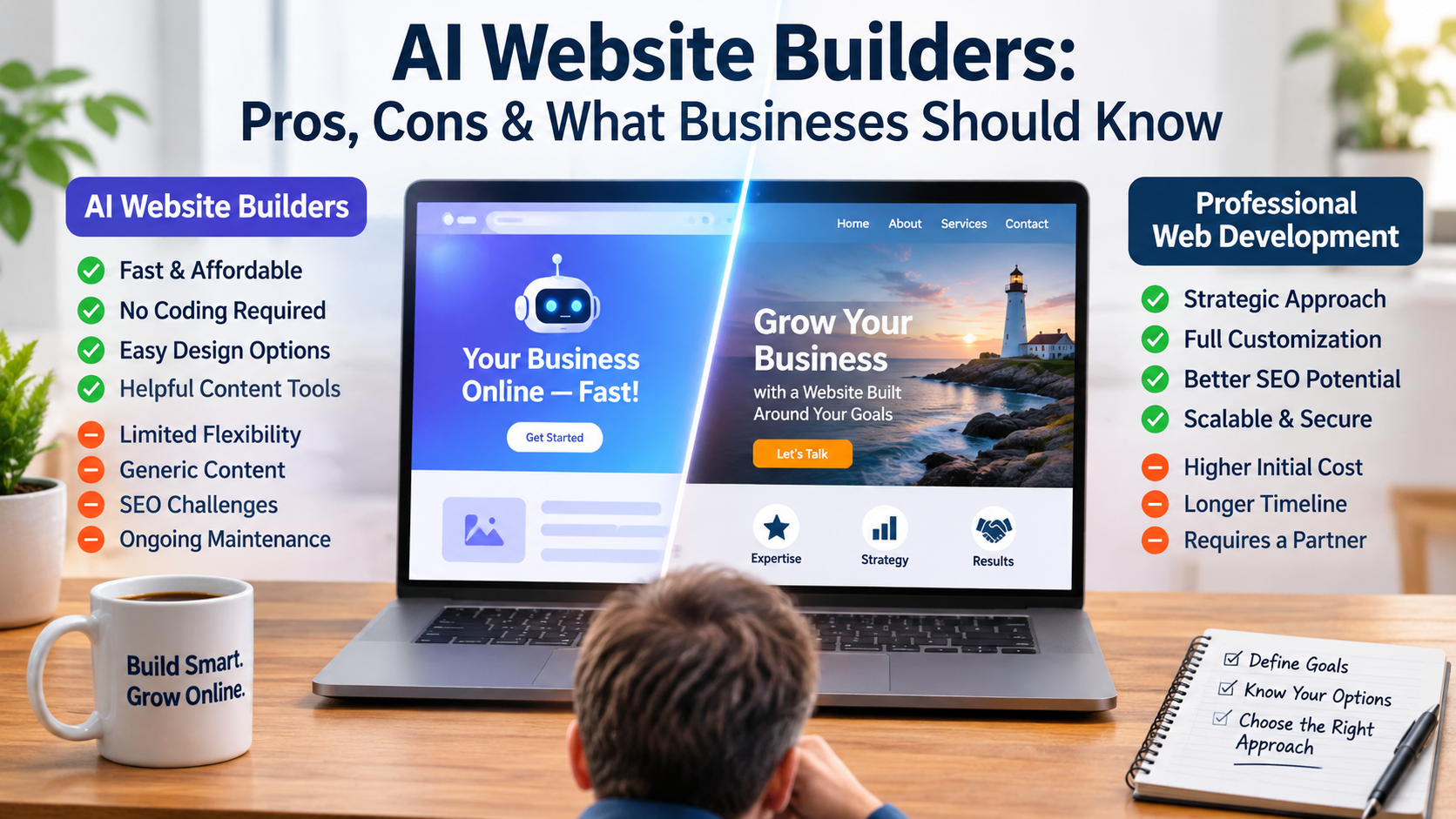
Artificial intelligence (AI) has changed the way we approach many aspects of running a business, and website development is no exception. What once required a professional web developer, graphic designer, and sometimes an entire marketing team can now appear to be just a few prompts away.
AI-powered website builders promise to create professional-looking websites in minutes. Simply describe your business, answer a few questions, and let AI generate a website complete with layouts, images, text, and even suggested features.
For small business owners, particularly those working with limited budgets, this sounds like an attractive alternative to hiring a professional.
But is building a website with AI really that simple? And more importantly, will the finished website accomplish what your business actually needs?
The answer depends on your expectations, technical knowledge, business goals, and how much control you want over your website.
Let’s look at the advantages and disadvantages of using AI to build a website, what AI can realistically do, and when working with a professional web developer may be the better investment.
What Does It Mean to Build a Website Using AI?
AI website development generally falls into a few different categories.
1. AI-Powered Website Builders
Platforms such as Wix, Hostinger, Durable, and other website-building services use AI to generate a website based on information you provide.
You might answer questions about your business, industry, services, preferred design style, and target audience. The platform then generates a website with a suggested layout, written content, images, and navigation.
You can typically edit the results using a visual website editor without knowing how to code.
2. AI Design and Content Tools
AI can also assist with individual elements of website development. These tools can generate website copy, suggest page layouts, create images, write headlines, develop calls to action, and help organize content.
Rather than building an entire website, AI becomes an assistant throughout the design and development process.
3. AI-Assisted Website Development and Coding
More advanced AI tools can generate HTML, CSS, JavaScript, and other code used to develop websites.
These tools can help developers build layouts, create custom functionality, troubleshoot problems, and speed up repetitive programming tasks.
However, generating code and developing a reliable, secure, fully functioning website are two different things.
Understanding these distinctions is important because not all AI website solutions offer the same level of flexibility, functionality, or control.
The Pros of Using AI to Build a Website
There are legitimate advantages to using AI for website development, especially for individuals and small businesses that need a basic online presence.
1. Lower Initial Costs
One of the biggest attractions of AI website builders is affordability.
Traditional website development can involve expenses for planning, design, development, content creation, and ongoing maintenance. Depending on the size and complexity of the project, professional website development can cost anywhere from a few thousand dollars to considerably more.
AI website builders often offer relatively inexpensive monthly subscriptions, making them appealing to businesses that cannot afford a larger upfront investment.
For a startup, independent consultant, or small business that simply needs a basic informational website, this can be a reasonable starting point.
However, it’s important to look beyond the advertised monthly price. Domain registration, premium features, additional applications, hosting, email services, and other subscriptions may increase the actual cost of ownership.
2. Faster Website Creation
AI can dramatically reduce the time it takes to generate an initial website.
Instead of starting with a blank page, AI can create a preliminary design, suggest navigation, generate page content, and recommend images.
What might otherwise take days of initial design and content development can sometimes be accomplished in minutes.
This is particularly useful for businesses that need a temporary website, a simple landing page, or a basic online presence while they work on a more comprehensive website.
The important distinction is that generating a website quickly does not necessarily mean the website is finished.
Content still needs to be reviewed, functionality tested, images evaluated, and the overall design refined to ensure it represents the business accurately.
3. No Coding Experience Required
Many AI website builders are designed for people without technical backgrounds.
You don’t need to understand HTML, CSS, JavaScript, or database management to generate a basic website.
Most platforms provide visual editing tools that allow you to change text, images, colors, layouts, and other design elements.
This makes website creation more accessible to small business owners who are comfortable working with technology but have little or no experience with web development.
For someone who enjoys managing their own website and has the time to learn the platform, this can be a significant advantage.
4. Assistance With Website Content
Writing website content can be one of the most challenging parts of building a website.
AI can help generate:
- Homepage headlines and introductory content.
- Business descriptions and service pages.
- Frequently asked questions.
- Blog articles and informational content.
- Calls to action.
- Page titles and meta descriptions.
- Suggested website navigation and page organization.
This can provide a useful starting point for business owners who struggle with writing or organizing their ideas.
However, AI-generated content should never be treated as automatically accurate or ready for publication.
AI does not inherently understand your business, your customers, your competitive advantages, or the specific reasons someone should choose your services.
Without careful editing and direction, the resulting content can sound generic, repetitive, or remarkably similar to that of competing businesses.
5. Easy Design Experimentation
AI can generate different design concepts, color combinations, layouts, and visual styles.
This allows business owners to experiment with different approaches without having to commission multiple design concepts.
You can ask AI to suggest a more modern appearance, simplify a layout, change the overall color scheme, or create a different presentation for your services.
For someone who is unsure what they want their website to look like, this can be a useful way to explore possibilities.
6. Helpful for Basic Website Maintenance and Troubleshooting
AI can also help website owners understand common technical issues.
For example, it can explain how to update website content, identify potential causes of broken links, suggest ways to improve page loading speeds, and provide guidance on common website errors.
More technically capable AI tools can even assist with code changes and troubleshooting.
This can be helpful for business owners who want to handle routine website updates themselves.
That said, AI recommendations should be reviewed before implementing changes, particularly when they involve website security, backups, databases, payment processing, or other critical functions.
The Cons of Using AI to Build a Website
While AI can make website development more accessible, there are some important limitations that business owners should understand before deciding to build their website entirely on their own.
1. A Website Can Look Good Without Being Effective
This is perhaps the biggest misconception about AI website development.
A website can look modern, attractive, and professionally designed while doing very little to generate business.
A successful business website needs more than attractive colors, appealing images, and well-formatted content.
It needs a purpose.
- Who is the intended audience?
- What problems are potential customers trying to solve?
- What information do visitors need before making a purchasing decision?
- What makes your business different from competitors?
- What action should visitors take?
- How will the website support your overall marketing efforts?
These are strategic questions that need to be answered before design and development begin.
AI can generate a layout, but it cannot automatically determine the best marketing strategy for your business.
Without a clear plan, you may end up with a website that looks impressive but fails to communicate your value, build trust, or encourage visitors to contact you.
2. Generic Content That Doesn’t Differentiate Your Business
AI-generated website content can be a helpful starting point, but it often lacks personality and originality.
If you ask an AI tool to write content for an accounting firm, landscaping company, restaurant, or professional services business, it will likely generate language that sounds appropriate for that industry.
The problem is that your competitors can ask essentially the same questions and receive very similar results.
Phrases such as “committed to providing exceptional service,” “your trusted partner,” and “solutions tailored to your needs” may sound professional, but they don’t necessarily tell potential customers anything meaningful about your business.
Effective website content should communicate your experience, approach, expertise, and unique value.
It should also reflect your brand’s personality and speak directly to the people you want to reach.
AI can help organize and improve that message, but the most valuable information needs to come from the business itself.
3. Limited Customization and Functionality
Not all AI website builders offer the same level of flexibility.
Many are designed around templates, predefined layouts, and built-in functionality. While this is convenient for basic websites, it can become restrictive as a business grows.
You may eventually need:
- Custom forms and application processes.
- Membership portals or restricted content.
- Appointment scheduling and booking integrations.
- Customer relationship management (CRM) integrations.
- Advanced search functionality.
- Online payment processing.
- Custom reporting and tracking.
- Specialized business applications.
- Integration with existing business systems.
Some AI website platforms offer integrations or applications to accommodate these needs, but availability, functionality, and customization options vary.
A website that works well for a business today may not accommodate its needs two or three years from now.
Before choosing an AI platform, consider not only what you need today but also how your website might need to evolve.
4. Search Engine Optimization (SEO) Is More Than Adding Keywords
AI tools can generate SEO-friendly headlines, page titles, meta descriptions, and content suggestions.
However, search engine optimization involves considerably more than inserting keywords into website content.
A comprehensive SEO strategy includes:
- Keyword research based on actual search behavior.
- Understanding search intent.
- Website structure and navigation.
- Internal linking.
- Technical SEO.
- Mobile usability.
- Page loading performance.
- Image optimization and accessibility.
- Local SEO and business listings.
- Quality, original, helpful content.
- Ongoing performance monitoring.
AI can assist with many of these activities, but it does not automatically create a comprehensive SEO strategy simply by generating a website.
For example, a local business serving Cape Cod needs to consider how potential customers search for its services, which geographic areas it serves, and what information will help it compete in local search results.
A generic website generated by AI may not address those considerations.
It’s also worth understanding that search engines do not automatically penalize content simply because AI was used to create it. The quality, originality, usefulness, and accuracy of the content matter.
The goal should be to create content that genuinely helps your audience, regardless of whether AI assisted with the writing.
5. Potential Accessibility Problems
Website accessibility is another area that can be overlooked when relying entirely on automated website generation.
A website should be usable by people with different abilities, including those who rely on screen readers, keyboard navigation, or other assistive technologies.
Accessibility considerations include:
- Appropriate color contrast.
- Descriptive alternative text for images.
- Proper heading structure.
- Keyboard-accessible navigation.
- Clearly labeled forms and buttons.
- Captions or transcripts for multimedia.
- Appropriate use of links and interactive elements.
AI-generated designs and content may include some accessibility features, but that does not mean the finished website is accessible.
Accessibility requires thoughtful implementation and testing.
For businesses, accessibility is not simply a design preference. It is an important part of providing an inclusive online experience and reducing potential legal exposure.
6. Security, Privacy, and Reliability Concerns
Website security is an area where business owners should be particularly cautious.
AI-generated code and automated website features can contain errors, vulnerabilities, or configurations that do not follow recommended security practices.
Some AI website builders handle much of the underlying hosting and security infrastructure, which can reduce the technical responsibilities of the website owner.
However, that does not eliminate the need to understand:
- SSL certificates and secure connections.
- Software and plugin updates.
- Website backups.
- User account permissions.
- Secure form submissions.
- Payment processing security.
- Privacy policies and data collection practices.
There are also privacy considerations when using AI tools.
Business owners should understand what information they are entering into AI platforms, how that information is stored, and whether it may be used to improve AI services.
Never assume that confidential customer information, financial records, or other sensitive business data can safely be entered into an AI tool.
7. Platform Dependency and Long-Term Flexibility
One of the most important considerations when selecting an AI website builder is ownership and portability.
Some platforms make it relatively easy to export website content or move to another service. Others have significant limitations.
You may be able to access your text and images but not easily transfer the underlying design, functionality, or website structure.
This can create a problem if:
- The platform increases its subscription prices.
- A feature you depend on is discontinued.
- Your business outgrows the platform.
- You want to move to a different hosting provider.
- You need functionality the platform cannot support.
Before committing to an AI website builder, find out what you actually own and what you are renting access to.
A lower initial cost is not necessarily a better long-term investment if moving away from the platform eventually requires rebuilding the entire website.
8. AI Doesn’t Eliminate the Need for Ongoing Maintenance
A website is not a one-time project.
It requires ongoing attention to remain accurate, secure, functional, and relevant.
Business information changes. Services are added or discontinued. Staff members change. Contact information needs updating. Software requires maintenance. Website performance and search visibility need monitoring.
AI can help with some of these tasks, but it cannot automatically take responsibility for ensuring that everything continues to work correctly.
Someone still needs to review the website, identify problems, make decisions, and ensure that changes are implemented properly.
For business owners already managing daily operations, this ongoing responsibility can become more time-consuming than anticipated.
AI Website Builder vs. Professional Web Development
So how does using an AI website builder compare with hiring a professional web developer?
The biggest difference is not necessarily how the website is built. It is the planning, expertise, customization, and ongoing support behind the finished product.
| Consideration | AI Website Builder | Professional Web Development |
|---|---|---|
| Initial cost | Generally lower | Higher initial investment |
| Development time | Often faster initially | Depends on project scope |
| Design | AI-generated templates and layouts | Customized to business needs |
| Content | AI-generated suggestions | Strategic, audience-focused content |
| SEO | Basic tools and recommendations | Strategic SEO planning and implementation |
| Functionality | Limited to platform capabilities and integrations | Greater flexibility and customization |
| Accessibility | Varies by platform and implementation | Can be addressed throughout development |
| Technical support | Platform-dependent | Direct professional assistance |
| Scalability | Depends on platform limitations | Can be planned around future needs |
| Maintenance | Primarily the owner’s responsibility | Can be included in a professional care plan |
Neither option is automatically right or wrong.
A small business with a limited budget and straightforward requirements may be perfectly comfortable using an AI website builder.
A business that relies heavily on its website to generate leads, communicate with customers, manage inquiries, or support revenue may benefit from a more strategic approach.
Can Professional Web Developers Use AI Too?
Absolutely.
In fact, AI is becoming a useful tool in professional website development.
The choice is not necessarily between using AI and hiring a professional. A professional web developer can incorporate AI into the development process while maintaining responsibility for the overall website.
AI can help with:
- Research and brainstorming.
- Initial content outlines.
- Design concepts and layout ideas.
- Writing and troubleshooting code.
- Identifying potential technical issues.
- Content editing and proofreading.
- SEO research and optimization assistance.
- Documentation and website planning.
Used appropriately, AI can help streamline development and make certain tasks more efficient.
However, the technology is a tool, not a replacement for professional judgment.
A developer still needs to understand the client’s business, determine the appropriate technology, evaluate the generated results, test functionality, and make sure the finished website meets the intended objectives.
The real value comes from combining technology with experience.
When Does Using AI to Build Your Website Make Sense?
An AI website builder may be a good option if:
- You are starting a business and need a basic online presence.
- You have a very limited budget.
- Your website only needs a few informational pages.
- You don’t require specialized functionality.
- You are comfortable managing and updating the website yourself.
- You have the time to learn the platform and troubleshoot problems.
- You understand that the initial design may need refinement as your business grows.
For example, a sole proprietor offering a small number of services may only need a homepage, an about page, a services page, and contact information.
An AI website builder could be a perfectly reasonable solution.
However, if your website is an important part of your marketing and business development strategy, the decision deserves more consideration.
When Should You Consider Hiring a Professional Web Developer?
Professional website development may be the better investment if:
- Your website is a primary source of new business inquiries.
- You need a customized design that reflects your brand.
- Your business offers multiple services or serves different audiences.
- You need custom forms, integrations, or specialized functionality.
- Search engine visibility and local SEO are important.
- Your existing website has technical problems or needs a significant redesign.
- You want a website that can grow with your business.
- You don’t have the time or interest to manage the technical side yourself.
One important distinction is that a professional web developer should not simply ask what colors you like and what pages you want.
They should also ask questions about your business, customers, competitors, marketing goals, and how the website will contribute to your overall business objectives.
That planning is an important part of the development process.
The Best Approach: Use AI as a Tool, Not a Replacement for Strategy
AI has made website development more accessible, and that is a good thing.
It gives small business owners more options, makes certain technical tasks easier, and can reduce the time and expense associated with creating a basic website.
But accessibility does not automatically translate into effectiveness.
A website is often one of the most important marketing tools a business owns. It represents your business online, communicates your services, establishes credibility, and helps potential customers decide whether they want to work with you.
The question shouldn’t simply be, “How quickly and inexpensively can I build a website?”
A better question is, “What does my website need to accomplish for my business?”
If the answer is simply to establish an online presence, an AI website builder may be sufficient.
If the answer involves attracting new customers, generating qualified leads, improving search visibility, communicating a competitive advantage, and supporting business growth, then a more comprehensive approach is worth considering.
AI can help build a website. It can help write the content, generate design ideas, and even produce much of the code.
But it still takes planning, experience, and informed decision-making to turn a collection of web pages into an effective business tool.
The bottom line: The best website isn’t necessarily the one built the fastest or at the lowest cost. It’s the one that works for your business, serves your customers, and supports your goals.
Considering a New Website for Your Business?
At Basimos Digital Marketing, I combine web development experience with a marketing-focused approach to help small businesses create websites that do more than simply look good.
Whether you’re considering an AI website builder, updating an existing website, or starting from scratch, it’s important to choose an approach that makes sense for your business today and as it grows.
Have questions about your website or which approach is right for your business? Let’s talk about your goals and explore the options.
